

On the Pembrokeshire coast is the holy well of St Gwyndaf, nestled in a ferny grove on the route to St David’s Cathedral. It’s listed in Guy Hayward and Nick Mayhew-Smith’s Britain’s Pilgrim Places (2020), and I was on holiday in the area trying to see as many sacred sites as possible. On my visit to St Gwyndaf’s, I found a collection of seashells surrounding the well opening with an invitation to take one. After pocketing the shell, I felt a bit of a fraud. I was a tourist, not a pilgrim. Despite spending a week in such a beautiful corner of Wales filled with wells, churches and standing stones, I was missing the special pilgrimage ingredient, whatever that is. Inspired by this sense of lack I booked myself on to a pilgrimage to Lindisfarne, following the St Cuthbert’s Way.
But can a Quaker go on a pilgrimage? I’ve met some who are adamant that such a journey is impossible from a Quaker perspective. This wariness of pilgrimage has several facets. Quakers believe that God can be met wherever we are. We don’t have to go anywhere to find God because God is waiting within. Quakers are also suspicious of performative religion. Quakers have tended to value the inward and spiritual over the outward and material, and so going an “outward” pilgrimage to a physical place means nothing if there is no “inward” spiritual, ethical change. This wariness might also spring from an antipathy to mainline church authority. Who gets to designate a place as more holy than another? The first Quakers shunned the supposedly consecrated ground of church buildings as sites of hypocrisy, and worshipped in homes and the outdoors, places the World called profane.
Although I get why some Quakers would see pilgrimage as a theological impossibility, I disagree with them. Quakers can go on a pilgrimage in a way that fits with core Quaker insights. Firstly, Liberal Quakers value personal experience of the Spirit, sometimes to the exclusion of all other sources of authority. In my experience, I went on a pilgrimage and through it was overwhelmed by the Spirit of Christ. Also, Quakers aim to make discernment a way of life. They seek a constant practice of living in accordance with the leadings of the Spirit of Love and Truth. My discernment of this Spirit led me to take a pilgrimage. The Spirit accompanied me on my way and was with me at the end. I also think Quakerism is a religion of freedom. We try not to put limits on what the Spirit can do. It’s not that no places are holy, or that all places are holy. We know from experience that different places can have different spiritual qualities. Rather, every place has the potential to be holy. The Spirit can make herself known anywhere she chooses.
Maybe Quakers are also suspicious of destinations. Quakers love the language of seeking over the language of finding. They prefer open questions to definite answers. A Quaker might say that it’s the journey that’s important, not the destination. I disagree. I think the destination gives us direction and purpose, and certain locations gain a kind of spiritual weight when they’ve been visited by so many people over the centuries. With that said, I also think the journey matters a lot. The attitude we travel with shapes how we arrive. I suspect that’s what makes something a pilgrimage, this affinity between journey and destination. If I want to feel like a pilgrim, then I need to journey as one. If Love and Truth are what I hope to find at the end, then Love and Truth have to shape my steps along the way. This could be an entry point into pilgrimage for Quakers. To make a pilgrimage is to embody the destination. In the movement known as Celtic Christianity, pilgrimage destinations like Lindisfarne are known as “thin places.” This phrase didn’t emerge from the mists of an ancient Celtic past, but was coined by George MacLeod, founder of the Iona Community. Nick Mayhew-Smith, in his The Naked Hermit (2019), writes of how we can see ourselves as “thin places”:
It is we who are thin, we who are stretched and made malleable in the embrace of something that overwhelms us, something that predates us and will outlive us. Beaten to the edge between the sea and the sky, the absolute smallness and frailty of the human framed within the cosmos is nothing if not a reminder of our gossamer-like being, suspended and sustained by the whole realm of nature. (p.127)
A place is “thin” when the spiritual, heavenly realms can be strongly felt seeping through into our material world, when heaven and earth feel intimately close. We can be “thin places” when we allow God’s light to shine through us. To pilgrimage to a “thin place” is to become one ourselves, open more fully to the Spirit’s transforming presence in our daily lives.
That could be a neat enough message to end with, but I’ve spent too long thinking about theology, race and the body to be comfortable with “thin places” as a metaphor. To speak of a “thin place” is to imagine the material world becoming paper-like and translucent, thin enough to let God’s spiritual light penetrate our otherwise dense world. This metaphor can be problematic in a culture that values the thin and light skinned over the fat and dark skinned. The saying that people with high social status have “blue blood” comes from the idea that nobility have skin pale enough to see their blue veins underneath. “Thin places” continues the associations between God, the pale and the slim. To do some theological repair work, we could subvert the metaphor and speak of “thicc places” instead. “Thicc” comes from Black North American slang, referring to women with curvy buttocks and fulsome hips, qualities that fall outside white standards of beauty. “Thicc” was introduced to me via the bears in my Instagram feed, bears being gay men who celebrate their hefty, hairy bodies. To be thicc is to revel in a big belly. As someone who was teased for being a chubby teenager, there’s something liberating in the phrase “thicc thighs save lives.”
I think there’s more theological truth in “thiccness” than thinness. The deeper I journey with and into God, the more authentically and vividly myself I become. I’m not fading away, I’m getting thiccer. In C. S. Lewis’s The Great Divorce (1945), souls in purgatory take a bus trip to heaven, but on exiting the bus they realise they are the flimsiest of ghosts. The grass feels like diamond shards under their see-through feet. A scattering of dew drops feels like a hail of bullets. They’re welcome to stay in heaven, but they must become more solid, more real, by taking the painful journey into the mountains. With each halting step they become weightier, fleshier. To grow into maturity in Christ is not to become pale, insubstantial and translucent, it’s to become thick ‘n’ juicy.
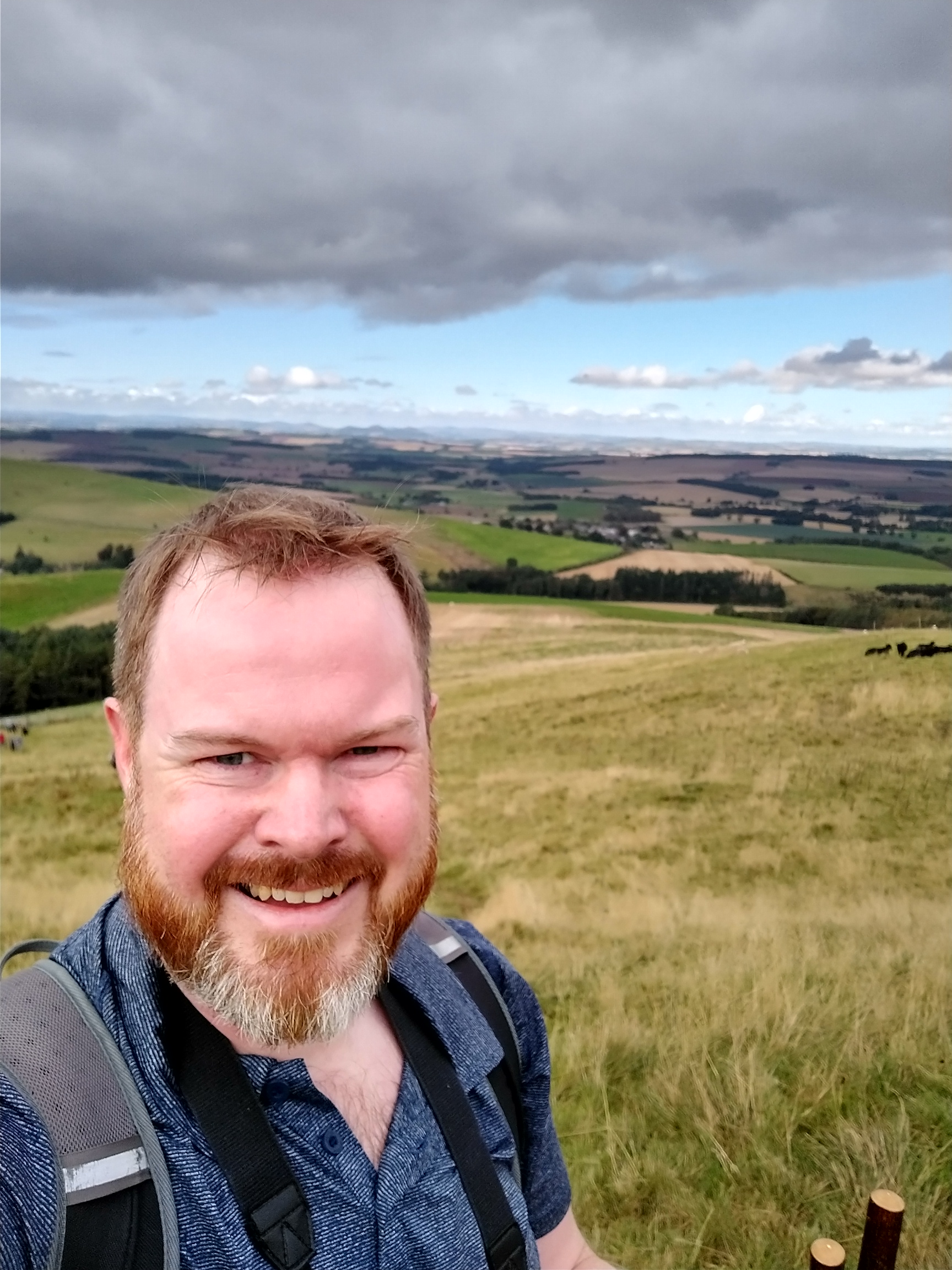
St Gywndaf’s Well felt like a “thin place” in a negative sense. There was something lacking. In contrast, every step of my pilgrimage to Holy Island was filled with the Real. As I spent each day outside, walking over hills, woods and meadows, through boggy moorland and alongside rivers, spotting birds and identifying mushrooms, I could feel myself thickening up. In the social sciences, researchers talk of writing “thick descriptions,” descriptions full of detail. This pilgrimage was a journey into the dizzying detail of God’s creation, as the landscape and weather, flora and fauna, changed about us with every hour. The final stage of the St Cuthbert’s Way takes you across the mudflats to Lindisfarne, which is traditionally walked barefoot. A series of wooden poles called “pilgrims posts” mark the safe route from shore to shore. The mud, sand and sea water were freezing. I don’t think my feet have ever been so painfully cold. At points the thick black mud was almost knee deep.
I walked this final part of the pilgrimage in silence, which is just as well as I was beyond speech by that point. The Lord of the Rings had been a topic of conversation during the pilgrimage, as we fancied ourselves a kind of Fellowship. My hazel thumb-stick definitely had Gandalf vibes. There’s a passage at the end of the book that perfectly captures how I felt at the end of this journey: “Their hearts, wounded with sweet words, overflowed, and their joy was like swords, and they passed in thought out to regions where pain and delight flow together and tears are the very wine of blessedness.” The fresh morning air was thick with the burbling of curlews and the hooting of seals. It was all so heavily real, saturated with the Divine Presence, and I was a part of it, a Quaker bear thicc with the Holy Spirit.
Thanks be to God for thicc places.
 Jolly Quaker
Thanks Mark – more useful and interesting words.
I have really enjoyed the various Pilgrimage series on the BBC. Partly because they travel to beautiful places and tell interesting stories but mostly because it is time taken to deal with bigger questions. I am not good at doing this in my daily existence and I suspect that is the case for many.
I love Othona as a thin place and while the setting plays apart it is mostly about how I am oriented when I am there, what I make space for and the conversations I have.
Thanks Alan!
Probably a boringly obvious comment, but I suspect the “real” pilgrimage is the solidarity we find with other travellers on the way.
I wonder if George Fox considered himself on pilgrimage with all the travelling he did. I doubt he would have used the language of thin or thick (thicc!) places but sometimes it feels like those early Quakers found it in prison. I’m no historian but I think they also went away to the farms and fields to get away from the noise and pressures. I was also reading about the Shakers, I’ve forgotten where now, but there was also something they managed to do by contrasting the noisy charismatic side of themselves with the quiet study and effort the put into making things. A pilgrimage within, perhaps?
Thanks Joe. I think the solidarity with fellow travellers is definitely an important part of the pilgrimage. The physicality of walking through the landscape made a huge impression on me, so I’d want to keep that as an essential pilgrimage ingredient. Maybe there’s something about finding solidarity not only with fellow human travellers, but with fellow creatures – trees, stones, birds, mountains, fungi – relearning to be one of God’s many creatures.
yes, I can see that. Also maybe something about a journey with a destination in mind which is different to a day out wandering in the woods. Maybe we all need to do the Camino de Santiago, maybe the uncomfortable-ness of the journey is part of the process of jogging something free in the heart. I’ll have to think about that (and try to persuade my life to let me go!)
Wife not life! I didn’t notice to autocorrect until after posting..